
18th C Antique Thai Ayutthaya Rattanakosin Gilt Lacquer Tin Alloy Buddha Figure
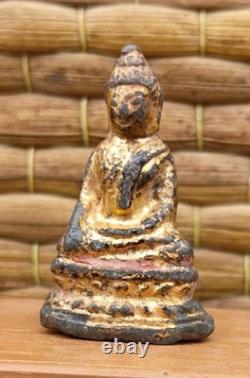
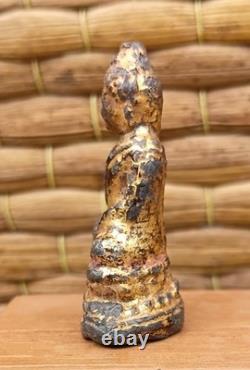
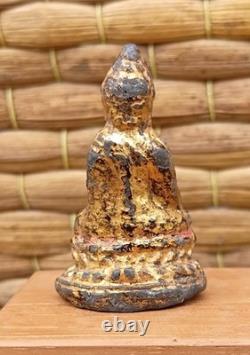
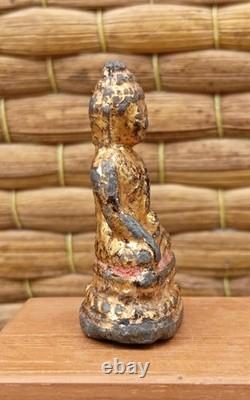

Object Name: Miniature Seated Buddha Figure. Historical Tradition: Late Ayutthaya to Early Rattanakosin, attributed. Date: Circa Late 18th - Early 19th Century CE, attributed. Material: Tin-rich metal alloy with black lacquer, gold leaf, red pigment, and an earthen core.
Posture: Seated Buddha in the Earth-Touching Gesture / Bhumisparsha Mudra. Form: A very small devotional image depicting the Buddha seated cross-legged upon an elevated, multi-tiered pedestal. Despite its miniature scale, the figure retains a strongly modeled frontal presence and a well-defined architectural base.
Iconography: The Buddha is shown with the left hand resting in the lap and the right hand extending downward toward the knee in the Earth-Touching Gesture, recalling the moment of enlightenment when the Buddha called the earth to witness. Facial Features: The face displays lowered eyes, a broad nose, gently curved mouth, elongated earlobes, and a rounded ushnisha terminating in a small pointed finial.
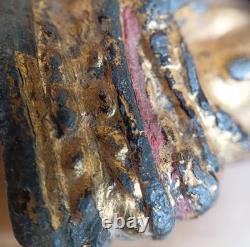
Raised curls define the hairline and crown. Robes: The monastic robe is worn diagonally across the torso, with raised linear folds defining the garment across the chest, shoulder, arms, and seated legs.Pedestal: The figure rests upon a layered lotus-form throne with raised petal ornament, horizontal moldings, and a broad rounded lower platform. A narrow band of surviving red pigment remains around the upper pedestal. Surface Decoration: Black lacquer was applied over the metal surface as a foundation for gold leaf. Large areas of gilding survive across the face, torso, robe, and pedestal, contrasting attractively with the exposed dark lacquer and metal beneath.
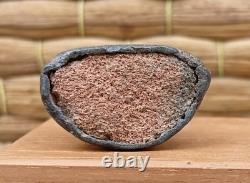
Construction: The open underside reveals a reddish, granular earthen core enclosed by the dark metal-alloy shell. The precise alloy and composition of the core have not been scientifically tested. Height: 42 mm / 1.65 in. Base Width: 28 mm / 1.10 in. Overall Condition: Good / Stable Antique Condition with Extensive Surface Wear.
Structural Details: The figure retains its complete overall silhouette, including the Buddha, head finial, seated body, lotus pedestal, and lower platform. No major structural break is apparent. Gilding & Lacquer: The gold leaf and black lacquer display extensive age-related loss, flaking, abrasion, cracking, and uneven wear. Surviving gilding remains strongest across the front of the face, torso, robe, and pedestal.
Metal Surface: Exposed areas show dark oxidation, pitting, softened detail, scratches, and small localized losses. The raised curls, facial features, robe folds, and lotus ornament remain recognizable. Core: The reddish earthen core remains visible through the open underside. A narrow gap is present between portions of the core and the surrounding metal shell, consistent with age and shrinkage of the internal material.
Additional Wear: The surviving red decorative band is faded and fragmentary. General deposits and surface discoloration are present throughout. Please examine all photographs carefully, as they form an important part of the condition description.Historical Attribution: The compact proportions, Earth-Touching Gesture, tiered lotus pedestal, lacquer-and-gold surface treatment, and surviving internal core are consistent with small Thai devotional images associated with the transition from the late Ayutthaya tradition into the early Rattanakosin era. Religious Meaning: In the Earth-Touching Gesture, the Buddha reaches toward the ground while meditating beneath the Bodhi tree. The gesture represents his calling the earth to witness his spiritual achievement and victory over the forces of Mara.
Gilding Tradition: Gold leaf was used to emphasize the sacred radiance and spiritual importance of Buddha images. The dark lacquer layer acted both as a preparation for gilding and as a protective decorative surface. Devotional Function: Miniature Buddha images could be kept for private worship, offered to temples, placed within shrines, or deposited in sacred architectural settings as acts of religious merit. Collecting Interest: The combination of its exceptionally small scale, surviving original gilding, black lacquer, red pigment, visible earthen core, and intact lotus throne makes this a particularly engaging study example of traditional Thai Buddhist metalwork.